Temple Emanu-El
The Plot Against AmericaTemple Emanu-El, identified as New York City’s largest synagogue, becomes the focal point of the public funeral for Walter Winchell. Its sanctuary hosts a major memorial service, while the procession and broadcasts beyond its walls make the institution the center of a citywide day of mourning—and a gathering place for political opposition.
Setting and Funeral Service
After Winchell is killed at a political rally in Louisville, his body is taken overnight by train to Pennsylvania Station, where it lies in state through the morning under the protection of New York City police. In accordance with Jewish custom, his funeral service is held that afternoon at Temple Emanu-El. The mayor, Fiorello La Guardia, has organized the mourning as a public civic occasion, with the service at the synagogue as its culmination.
The scale of the observance reaches well beyond the building. Thirty thousand mourners file past Winchell’s flag-draped coffin at Pennsylvania Station, and the cortege proceeds to Temple Emanu-El under a police motorcycle honor guard. Dignitaries fill every seat in the synagogue, including the ten members of Franklin D. Roosevelt’s 1940 cabinet and four of his appointees to the Supreme Court of the United States. Loudspeakers carry the service out to crowds across Manhattan and to visitors who have come to Winchell’s hometown to pay their respects.
The Memorial as a Public Spectacle
The service joins religious observance to municipal ceremony. La Guardia leads the procession and delivers the funeral oration inside the synagogue; the city’s mourning also includes a minute of silence observed across the five boroughs. Outside, mourners wear black-and-white buttons bearing a question about Lindbergh, making the memorial’s grief inseparable from public dissent.
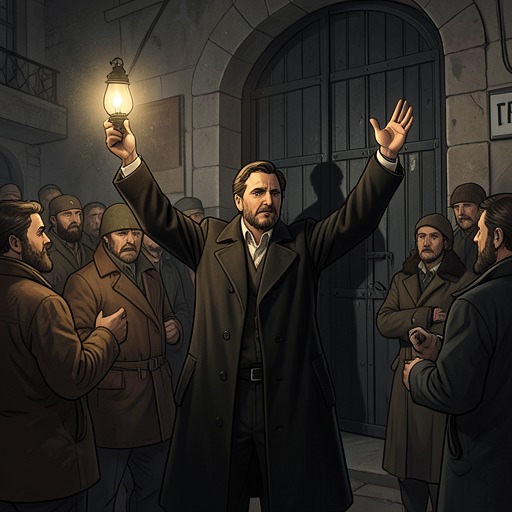
La Guardia’s address presents Winchell as an opponent of fascism and antisemitism, and connects his assassination to the political climate under the president. As the mayor repeats his challenge from the pulpit, listeners gathered at loudspeakers throughout the city take up the cry. Temple Emanu-El thus becomes both the site of a funeral and the point from which a local memorial is amplified into a collective protest.
Political Consequences and Significance
The synagogue service culminates in an unexpected political declaration. Franklin D. Roosevelt appears after La Guardia’s oration and names the mayor as Winchell’s successor, pledging support for him as a national-unity candidate against Lindbergh’s bid for a second term in 1944. The announcement turns the funeral into a platform for a renewed political contest.
Temple Emanu-El’s role in the episode is therefore more than ceremonial. Its sanctuary gathers religious mourning, civic leadership, and organized opposition in one charged public event. The contrast between the solemn funeral and the political action that emerges from it makes the synagogue a focal setting for the story’s transformation of private loss into collective resistance.